
Published 12 November 2026 · 12 minute read · Reviewed by the Elite Branding team
The short answer
Cotton usually suits teams prioritising a natural feel and absorbency; engineered polyester suits uniforms that need to dry quickly and support active work with easy care; and a cotton and polyester blend is often the safest choice for varied needs. There is no universal winner. Choose for the work environment, laundry routine, decoration method and replacement budget rather than the fibre name alone.
The expensive mistake: buying for appearance instead of use
A buyer approves a polo because the sample looks polished. A month later, outdoor staff complain that it feels damp, office staff are ironing it every morning, or a lightweight fabric puckers around a dense embroidered logo. The order was not necessarily low quality; it was a mismatch between fabric, role and decoration.
Start with the conditions the garment must survive. Ask how much the wearer moves, how warm the workplace is, who launders the uniform, whether a crisp appearance for customers matters and how often replacements can be issued.
Cotton, polyester and blends compared
| Decision factor | 100% cotton | 100% polyester | Cotton and polyester blend |
|---|---|---|---|
| Feel | Natural, soft hand; feel varies by yarn and finish | Can feel smooth or technical; quality and knit make a large difference | Balances cotton feel with synthetic stability |
| Moisture behaviour | Absorbs more moisture and can feel heavy when saturated | Absorbs little into the fibre; engineered knits can move moisture and dry quickly | Performance depends on ratio, yarn and finish |
| Creasing | More likely to crease and need pressing | Generally less prone to creasing and easy to care for | Usually easier care than pure cotton |
| Heat sensitivity | Tolerates a hotter iron when the care label permits | Needs lower heat; excessive heat can glaze or damage fibres and decoration | Use the temperature required by the fibre that is most sensitive to heat and follow the label |
| Best starting point | Indoor roles, teams seen by customers and roles prioritising comfort | Active, outdoor and sport programs, or uniforms that require frequent washing | Teams with varied roles that need comfort plus practical care |
| Budget pattern | Premium cotton can cost more, but not always | Polyester at an entry price is often economical; technical recycled options can cost more | May carry a premium when construction is heavier or backed with cotton |
This is a selection guide, not a performance guarantee. Fabric construction, GSM, fit and finish can outweigh fibre content. Always assess the actual garment and care label.
What do current market numbers tell us?
Textile Exchange estimated global fibre production at about 132 million tonnes in 2024. Polyester represented approximately 59%, or 77.7 million tonnes, while cotton represented about 19%, or 24.5 million tonnes. Polyester's scale helps explain its broad availability across entry price, performance and premium uniform ranges.
Synthetic fibres' combined share of global production in 2024.
Polyester's share of global fibre production in 2024.
Cotton's share of global fibre production in 2024.
Source: Textile Exchange, Materials Market Report 2025, reporting 2024 global production. Market share describes supply, not which fibre is best for a particular uniform.
Is polyester always cheaper than cotton or a blend?
No. Polyester is often available at a lower entry price, but fibre content alone does not determine garment cost. Weight, knit, recycled content, collar construction, colour, size range, finishing, decoration and order quantity can move the final price substantially.
The figures below are an illustrative market average based on indicative Australian pricing for comparable polos. They are intended only to show what buyers may typically encounter.
They are not Elite Branding prices, a quote, a guaranteed market rate or evidence of what every buyer is willing to pay. Actual prices vary by supplier, garment specification, fabric weight, construction, branding, quantity, freight and timing.
In this illustration, a 100% polyester micromesh polo is compared with a heavier cotton backed option made from 60% polyester and 40% cotton, with the blend shown at 9.5% to 12.5% more across the selected quantity tiers.
| Quantity | 100% polyester polo | 60/40 cotton backed polo | Blend premium |
|---|---|---|---|
| 200 to 299 | $32 ex GST each | $36 ex GST each | 12.5% |
| 50 to 99 | $37 ex GST each | $41 ex GST each | 10.8% |
| 10 to 19 | $42 ex GST each | $46 ex GST each | 9.5% |
For a team of 100 people receiving three polos each, that example's $4 difference equals $1,200 ex GST before freight or other changes. The correct question is whether the more expensive option reduces complaints, ironing, replacements or low wear rates enough to justify the difference.
Which fabric is more breathable?
Cotton generally absorbs more moisture, while a well designed polyester fabric can move and dry moisture faster. Breathability is not decided by fibre content alone. Knit openness, fabric weight, surface finishes, fit and airflow can make one polyester polo cooler than another cotton polo, or the reverse.
A US ENERGY STAR textile guide lists typical moisture regain at 7.0% for cotton and 0.4% for polyester. On that measure, cotton's typical regain is 17.5 times polyester's. This helps explain why cotton absorbs perspiration but may remain wet and feel heavier, while polyester takes little moisture into the fibre itself.
Source: ENERGY STAR textile industry guide, Table 28. Moisture regain is a laboratory fibre measure; it is not a complete rating of garment comfort.
Which option needs the least ironing?
Polyester usually needs the least pressing, blends sit in the middle, and pure cotton is more likely to need ironing for a crisp presentation. This makes easy care polyester or a blend attractive where employees wash uniforms at home or the organisation wants a consistent appearance with less preparation.
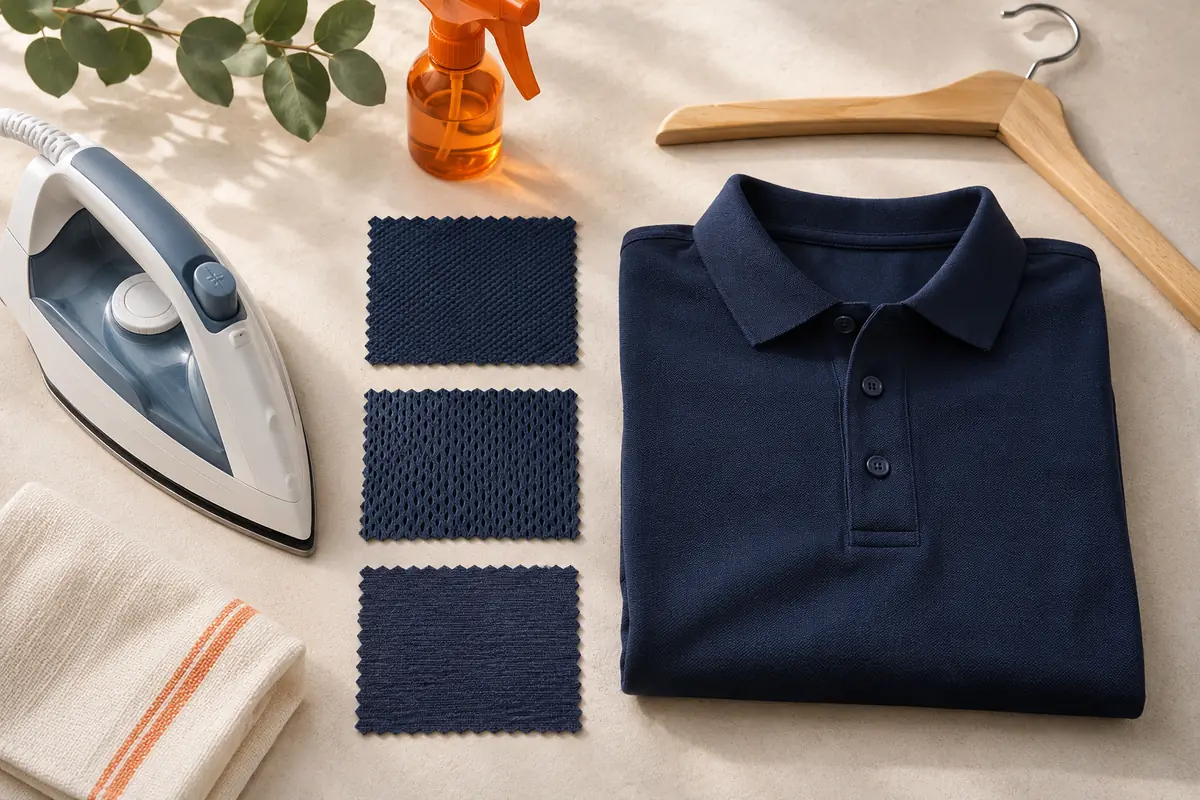
| Fabric | Typical care implication | Ironing guidance |
|---|---|---|
| Cotton | More prone to visible creasing; steam can help | Often supports high heat when the garment label permits |
| Polyester | Lower crease tendency; often suitable for hang drying | Use low heat and protect decoration; excessive heat may damage or shine the surface |
| Blend | Usually easier care than pure cotton | Use the setting for the fibre that is most sensitive to heat and follow the garment label |
The ACCC recognises care label iron limits of 110°C, 150°C and 200°C. The exact safe setting comes from the garment's label, not this guide. See the ACCC guide to care labelling.
Pros and cons of 100% cotton uniforms
Advantages
- Natural hand feel that many wearers recognise immediately.
- Higher moisture absorption than polyester fibre.
- Traditional retail presentation for teams seen by customers.
- Suitable for many embroidery and print applications when garment construction is appropriate.
Considerations
- Can hold absorbed moisture and take longer to dry.
- Usually creases more and may need hotter ironing.
- Fit, shrinkage and colour retention depend on fabric treatment and care.
- Premium cotton garments can increase the initial uniform budget.
Pros and cons of 100% polyester uniforms
Advantages
- Low moisture regain and potentially fast drying.
- Generally easy care with lower crease tendency.
- Widely available across active, sport and entry price ranges.
- Works well with sublimation when the garment and artwork are designed for it.
Considerations
- Dense or poorly engineered fabric can feel hot or clammy.
- Requires lower ironing heat.
- Dye migration can affect some decorations applied with heat, so testing matters.
- A technical or recycled polyester garment is not automatically the cheapest option.
Pros and cons of cotton and polyester blends
Advantages
- Combines some cotton feel with polyester stability and easier care.
- Useful for mixed indoor and active roles.
- Ratios such as 50/50 or 65/35 let buyers prioritise different characteristics.
- Often a practical default for uniform programs that cover varied roles.
Considerations
- Performance varies widely by blend ratio and fabric construction.
- May cost more than a polyester equivalent at an entry price.
- Still requires the lower safe heat setting where polyester is present.
- The word “blend” does not guarantee breathability or quality.
Which fabric suits each industry?
| Industry or role | Best starting point | Why |
|---|---|---|
| Corporate and reception | Cotton rich or quality blend | Balances natural feel, presentation and repeatable branding. |
| Hospitality and retail | Blend or easy care performance polyester | Supports frequent laundering and a consistent appearance; test comfort in the actual venue. |
| Trades, transport and warehousing | Performance polyester or durable blend | Useful for active roles and faster drying; garment safety requirements take priority. |
| Healthcare and care services | Easy care blend or performance fabric specific to each role | Choose around laundering, movement, pockets, role identification and workplace policy. |
| Sporting clubs and fitness | Performance polyester | Supports lightweight construction, moisture movement and sublimated designs. |
| Education and administration | Blend or cotton rich polo | A practical balance of presentation, comfort and home laundering. |
No fabric choice replaces a risk assessment specific to each role. High visibility, heat, flame, chemical and other regulated environments require garments selected to the relevant workplace requirements rather than simply a preference for cotton or polyester.
Does fabric choice affect embroidery and printing?
Yes. The fabric's stability, texture, heat sensitivity and dye behaviour influence the decoration method. A stable pique polo can support embroidery, while detailed full colour artwork may suit DTF printing. Larger simple designs may favour screen printing, and polyester garments designed for sublimation can carry colour across the whole garment.
Lightweight fabric may need adjusted stitch density and stabilisation. Polyester should be tested for dye migration before decoration is applied with heat. Cotton and blends can also react differently to heat and pressure. Approve a decorated sample when fabric, logo complexity or colour behaviour creates uncertainty.
How to make the decision in five steps
1.Define the work
Document movement, temperature, exposure, customer contact and any safety requirements.
2.Calculate the whole cost
Compare the garment, decoration, freight, care effort, likely wear rate and replacement process rather than the blank price alone.
3.Check the laundry reality
Decide whether staff will iron at home, garments require commercial laundering, or quick overnight drying matters.
4.Match the decoration
Assess logo size, colours, gradients, placement and the fabric's response to stitching, heat and ink.
5.Test a sample by wearing it
Have representative roles wear and wash the proposed garment before committing to a large rollout.
Questions buyers ask before ordering
Is cotton or polyester better for hot weather?
Neither fibre wins in every hot workplace. Cotton absorbs more moisture and may feel comfortable during less intensive work, while lightweight engineered polyester can move moisture and dry faster during sustained activity. Fabric weight, knit openness, fit and airflow must be considered with fibre content.
Is a higher GSM always better quality?
No. GSM measures fabric mass per square metre, not overall quality. A heavier polo may feel substantial, but it can also retain more heat. Yarn, knit, finishing, collar construction, seams and intended use determine whether the weight is appropriate.
What is the best blend ratio for work polos?
There is no universal ratio. A 65% polyester and 35% cotton blend generally leans toward easy care and stability, while a cotton rich blend leans toward natural feel. The actual garment should be assessed because different knits with the same ratio can behave differently.
Which option delivers the best value?
The best value is the garment employees consistently wear and the organisation can reorder reliably. A cheaper polo that is uncomfortable or unsuitable can create hidden replacement and adoption costs; an expensive garment is poor value if its premium features are irrelevant to the role.
Can one fabric cover every department?
Sometimes, but forcing one garment across office, warehouse and outdoor roles often creates compromises. A coordinated range can use different fabrics while keeping colours, logos and styling consistent.
Choose with confidence
Match the garment to the job before you request a quote
Use the Product Picker to capture role, environment, quantity and branding needs. Then discuss a coordinated uniform range with the Elite Branding team.
Research sources and limitations
- Textile Exchange Materials Market Report 2025: 2024 global fibre production and market shares.
- US ENERGY STAR textile industry guide: typical fibre moisture regain values.
- ACCC Product Safety guide to care labelling: Australian care symbols and maximum iron temperatures.
Percentages and prices are labelled with their reporting period and context. Product pricing changes, and a published supplier example does not predict the price of another garment or order. Request a current itemised quote for an actual purchasing decision.